_edited.jpg)
Hawa Mahal Jaipur Tour History, 953 Windows, Best Photo Tips and Nearby Attractions

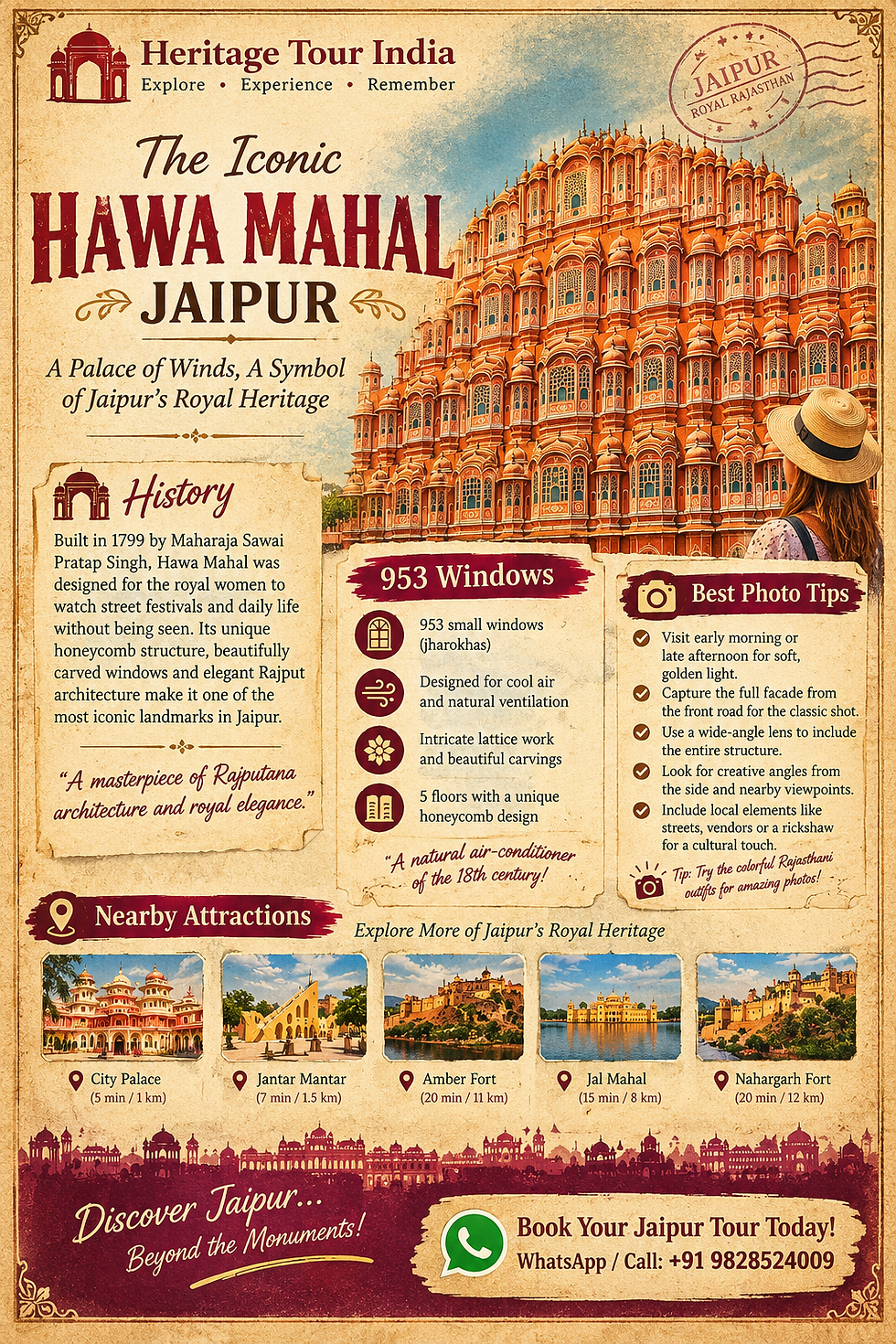
Hawa Mahal is one of those rare monuments that looks familiar even before you see it in person. Its honeycomb façade appears on postcards, travel posters, guidebooks, and countless Jaipur itineraries. Yet standing across the road from it in the soft morning light feels different. The palace rises like a carved screen of pink sandstone, full of tiny windows, delicate arches, and quiet royal stories.
A good Hawa Mahal tour is not just a quick photo stop. It can become the heart of a Jaipur heritage walk if planned well. This guide shows how to explore the palace with context, where to stand for the best photographs, when to visit, and what to add nearby so the day feels complete.Jaipur Tourist Attractions: Top Places to Visit in the Pink City

1. Start with the story behind Hawa Mahal
Hawa Mahal was built in 1799 by Maharaja Sawai Pratap Singh, a ruler of Jaipur from the Kachwaha Rajput dynasty. The palace was designed by Lal Chand Ustad, and its name means the Palace of Winds.
The monument was not built as a conventional palace for royal residence. It worked more like an elegant viewing gallery attached to the royal quarters. The women of the royal household could watch street processions, festivals, and daily city life from behind the screened windows without being visible from the street.Best Tour Guide in Jaipur | Govt. Approved & 5-Star Rated | Heritage Tour India
This idea is central to understanding the building. Hawa Mahal is beautiful, but it is also practical. It blends privacy, climate comfort, royal culture, and urban design in one striking façade.
Its location also matters. The palace stands on the edge of Jaipur’s old city, close to the City Palace and Jantar Mantar. This puts it right inside the historic core planned under Maharaja Sawai Jai Singh II, who founded Jaipur in the early 18th century. The streets around it still carry the rhythm of the old market city, with jewellery shops, textile stores, snack stalls, temple bells, and cycle rickshaws moving through narrow lanes.Female Tourist Guide in Jaipur – Explore the Pink City with Confidence, Comfort & Local Expertise
For anyone planning a heritage tour India itinerary, Hawa Mahal offers a compact but rich introduction to Jaipur’s royal past, craft traditions, architecture, and street life.
2. Notice why the architecture feels so light
The first thing most visitors notice is the façade. It looks tall, narrow, and delicate, almost like a stage backdrop. Hawa Mahal rises to five storeys, but it has a surprisingly shallow depth compared with its height and width. This gives the outer face its famous screen-like quality.
The building uses red and pink sandstone, matching Jaipur’s old city character. Its colour changes through the day. In the morning, it can look warm peach-pink. By late afternoon, it may seem deeper and more muted, especially when the market shadows lengthen.
The façade is often compared to a crown. Many traditions connect its outline with the crown of Lord Krishna, as Maharaja Sawai Pratap Singh was known to be devoted to Krishna. Whether viewed through faith, design, or artistry, the effect is unmistakable. The top curves, small domes, and layered patterns make the building feel both royal and playful.
Hawa Mahal also reflects a blend of Rajput and Mughal architectural elements.
Look for these details as you stand outside:
Jharokhas
These are projecting windows or enclosed balconies, common in Rajasthan’s royal buildings.
Latticework
The carved screens allow air and filtered light to pass through while preserving privacy.
Chhatris
Small domed pavilions add rhythm to the roofline and upper sections.
Arched openings
The repeated arches create symmetry and visual depth.
Floral and geometric motifs
These fine details reward slow looking, especially from the opposite side of the road.
The palace was also designed for Jaipur’s hot climate. Its many openings helped air move through the structure. The jharokhas created a cooling effect, which is why the building earned the name Hawa Mahal. “Hawa” means wind or air, and the name still fits.Golden Triangle Tour from Jaipur: Explore India’s Cultural Heart
Hawa Mahal is not powerful because of size alone. Its genius lies in how it uses air, light, privacy, and ornament at the same time.

3. Count the windows and understand the famous façade
The number most associated with Hawa Mahal is 953. That is the widely cited count of its windows, or jharokhas, spread across the façade.
These windows are not random decoration. They shape the entire identity of the palace.
From across the street, the façade looks like a honeycomb. Each small window sits within a repeated pattern, yet the whole front does not feel flat. Tiny projections, arches, canopies, and layered stonework create a sense of movement. The building seems to breathe.Amer Fort Light and Sound Show Timings, Ticket Price, Booking & Visitor Tips
The 953 windows had several purposes.
They allowed royal women to see street life while remaining screened from public view. They also helped air circulate through the palace. In Jaipur’s dry heat, this mattered. The tiny openings and latticed designs reduced direct sunlight while letting in breeze and soft light.
Inside, the experience changes. Many first-time visitors expect vast halls, but Hawa Mahal is more vertical, compact, and inward-looking. The rooms and passages are relatively simple compared with the ornate exterior. That contrast is part of the charm. The outside was made for spectacle. The inside served movement, viewing, and comfort.Night Jaisalmer Desert Experience: Your Complete Desert Night Adventure
As you move through the palace, notice how the view of the city keeps changing through the openings. Instead of one grand balcony, Hawa Mahal offers hundreds of framed glimpses. A market roof here, a temple spire there, a line of traffic below, a slice of sky above.
That is the real magic of the façade. It does not only ask to be photographed. It teaches you to look through it.
4. Plan your visit for the best light and comfort
Timing can change your Hawa Mahal experience completely. The palace sits beside a busy road and market area, so light, traffic, weather, and crowd levels all matter.
Choose the right season
The most comfortable months for a Jaipur trip are usually October to March. Days are more pleasant, especially for walking between nearby attractions. Winter mornings can be cool, so a light layer helps.
April to June can be very hot. If visiting in summer, aim for an early start and avoid long outdoor walks in the afternoon. The monsoon months bring humidity and occasional rain, but the washed sandstone can look beautiful after a shower.Nahargarh Biological Park: Jaipur’s Wildlife Haven
Arrive early for the classic photo
The façade faces east, so morning light works best for the famous front view. Try to arrive soon after opening hours, or at least early enough to catch soft light before the street gets too busy.
Early morning also gives a calmer experience. Shops are opening, traffic is lighter, and the palace front looks cleaner in photographs.
Use late afternoon for atmosphere
Late afternoon is not always ideal for the classic front-lit façade, but it has its own mood. The nearby bazaars are active, snack stalls get busier, and the old city feels alive. If photography is not your only goal, this can be a rewarding time to soak in the area.Jaipur Heritage Evening Walk: Explore the Pink City After Dark
Avoid rushing the interior
Many visitors stop outside, take a photograph, and leave. That is fine if time is short, but the palace deserves more.
Give yourself enough time to:
View the façade from across the road
Walk inside and climb through the levels
Look out through the jharokhas
Read basic information boards if available
Visit nearby lanes and shops slowly
A relaxed visit can take about an hour or more, depending on how much you enjoy photography and architecture. If combining it with City Palace and Jantar Mantar, plan a half-day in the old city.Amer Fort Jaipur: Exploring the Crown Jewel of Jaipur
5. Capture better photos without blocking the street
Hawa Mahal is one of Jaipur’s most photographed landmarks, but it can be tricky to shoot well. The road in front is busy, the façade is tall, and the best angles often need patience.
A few simple choices can make your photographs much stronger.
Stand across the road for the full façade
To fit the whole structure in the frame, cross to the opposite side when safe and look for a clear viewpoint. This gives the classic postcard composition. A wide-angle lens helps, but even a phone can work if you step back enough.Jaipur Shopping Tour: Discover the Pink City’s Treasures
Keep the building straight in your frame. Since Hawa Mahal is tall, phones often tilt the vertical lines if pointed sharply upward. Step back, hold the camera steady, and use grid lines if your phone has them.
Use the morning sun
Because the façade faces east, morning light brings out the colour and detail. Soft light also reduces harsh shadows and makes the pink sandstone glow.
If the sun is too strong, wait for a passing cloud or shoot from a slight angle. Direct midday light can make the surface look flat and washed out.Female Tourist Guide in Jaipur – Safe, Empowering & Memorable Tours
Try tighter detail shots
Do not take only the full frontal image. The smaller details tell the story better.
Look for:
Repeating window patterns
Lattice shadows
Arched balconies
Small domes at the upper levels
People framed naturally by windows inside
A zoom lens or phone telephoto mode can help capture the jharokhas without distortion.
Photograph from inside the palace
Inside, use the windows as frames. Shoot through a jharokha towards the street, or capture light falling across the walls. These images feel more personal than the standard exterior shot.
Be careful in narrow passages. Let others pass, avoid blocking stairways or ramps, and do not lean dangerously from balconies or windows.Pink City Best Tour Guide in Jaipur – Heritage Tour India
Include the street for scale
A clean façade photo is useful, but one or two images with passing rickshaws, pedestrians, or shop signs can show the monument in context. Hawa Mahal is not isolated from Jaipur. It belongs to the working old city around it.

6. Walk the inside with attention to views and airflow
Once inside Hawa Mahal, slow down. The exterior is famous, but the interior explains how the building worked.
The palace has a series of levels with passages, chambers, and viewing points. Instead of grand staircases everywhere, parts of the structure use ramps, which are often associated with ease of movement within royal buildings. The upper floors become narrower as you climb, and the views get wider.
Look through the small windows and notice how the air moves. The design is not only ornamental. Even today, you can sense how the openings soften the heat and connect the interior with the street.
As you explore, keep an eye on three experiences.
Watch the old city through the jharokhas
From the windows, Jaipur appears in fragments. A market lane, a roof, a temple top, a signboard, a passing scooter. The view changes with each opening. This helps you understand why the palace was such an effective viewing screen.
Look up at the roofline
From certain points, you can see the domes, parapets, and upper details more closely. The façade that looks flat from the street becomes layered from within.
Notice the contrast between front and back
The famous façade feels ornate and theatrical. Other parts are plainer, built for circulation and use. This contrast often surprises visitors, but it makes the building more interesting. It shows how design served both royal display and daily function.
7. Add nearby attractions to make it a richer Jaipur tour
Hawa Mahal sits in one of the best areas for a walking or short-drive heritage route. Instead of treating it as a single stop, combine it with nearby landmarks.
City Palace
The City Palace is a natural pairing with Hawa Mahal. It was the royal seat of Jaipur and includes courtyards, gateways, museums, and palace buildings. The famous doors of Pritam Niwas Chowk are especially popular for photography.
Visit City Palace before or after Hawa Mahal, depending on your schedule. Together, they give a better sense of Jaipur’s royal world.
Jantar Mantar
Jantar Mantar, a UNESCO World Heritage Site, lies close to City Palace. It contains large astronomical instruments built under Maharaja Sawai Jai Singh II. The site is fascinating because it shows scientific ambition in stone and masonry.
If possible, take a guide here. The instruments make much more sense with explanation.
Govind Dev Ji Temple
Located near the City Palace area, Govind Dev Ji Temple is one of Jaipur’s most loved Krishna temples. If timing allows, attend an aarti respectfully. Dress modestly, follow local instructions, and avoid intrusive photography.
Johari Bazaar
Johari Bazaar is known for jewellery, textiles, lac bangles, and traditional Rajasthani shopping. Even if you do not buy much, walking through the market adds local texture to the day.
Bargaining is common in many shops, but stay polite and realistic. If you are buying valuable jewellery or gemstones, choose a trusted store and ask proper questions.
Bapu Bazaar and Tripolia Bazaar
These markets are good for textiles, juttis, handicrafts, and everyday Jaipur shopping. They can be busy, but they are rewarding if you enjoy colour, craft, and local street scenes.
Isarlat or Sargasuli Tower
This historic tower near the old city offers another way to read Jaipur from above, when access is available. It gives a different perspective on the city’s planned layout and old streets.
8. Include local experiences around Hawa Mahal
The best Jaipur days mix monuments with small local moments. Around Hawa Mahal, these are easy to add.
Taste classic Jaipur snacks
Near the old city markets, try familiar Rajasthani and North Indian snacks from clean, busy places. Options may include kachori, samosa, lassi, kulfi, or masala chai. Choose stalls with high turnover and avoid anything that looks stale.
If you want a fuller meal, look for dishes such as dal baati churma, gatte ki sabzi, ker sangri, or a Rajasthani thali.
Shop for crafts with patience
Jaipur is known for block-printed textiles, blue pottery, miniature paintings, lac bangles, quilts, leather juttis, and silver jewellery. Around the old city, you will find many shops selling both everyday items and tourist-focused goods.
Before buying, compare quality and prices. Handmade work may cost more, and good pieces usually show better finishing.
Take a guided heritage walk
A guided walk through the old city can add stories that are easy to miss alone. A good walk may cover gates, havelis, temples, bazaar traditions, food stops, and craft clusters. This helps connect Hawa Mahal with the larger history of Jaipur rather than viewing it as a standalone photo spot.Jaipur Night Jeep Safari – Explore the Illuminated Pink City With Private Tour Guide
Ride a cycle rickshaw for short distances
For short routes through the old market area, a cycle rickshaw can be practical and atmospheric. Agree on the fare before starting. Keep small change handy.
Pause at a rooftop viewpoint
Some cafés and terraces across from Hawa Mahal offer elevated views of the façade. If you choose one, go for the view and a short break rather than expecting silence. The road below stays active through the day.

9. Follow a simple half-day Hawa Mahal itinerary
If you want a smooth plan, use this half-day route. It keeps walking distances practical and balances monuments, photos, markets, and food.
Time | What to do | Why it works |
8:00 am | Reach Hawa Mahal façade | Morning light is best for photographs |
8:15 am | Take exterior photos from across the road | You get the full honeycomb view before heavy crowds |
8:45 am | Enter Hawa Mahal | The interior feels calmer early in the day |
10:00 am | Walk to Jantar Mantar | It is nearby and best understood with time |
11:00 am | Visit City Palace | The royal context completes the story |
1:00 pm | Eat lunch or snacks in the old city | A local food stop makes the tour more memorable |
2:00 pm | Browse Johari Bazaar or Bapu Bazaar | Add craft, textiles, and street life to the route |
If you prefer a slower day, split this into two parts. Visit Hawa Mahal, Jantar Mantar, and City Palace on one day, then return to the markets for dedicated shopping and food.
10. Prepare well for a comfortable visit
A Hawa Mahal tour is simple to arrange, but a few practical choices help.
Carry:
A bottle of water
Sunglasses and sunscreen
A light scarf or cap in summer
Comfortable walking shoes
A phone or camera with enough battery
Small cash for snacks, rickshaws, and local purchases
Wear light, breathable clothing if visiting in warm months. Jaipur involves plenty of walking, and old city lanes can feel hotter during midday.Tempo Traveller & Bus Rental Service in Jaipur – Group Travel Made Easy
Keep your tickets safe if you buy entry passes. Some Jaipur attractions offer different ticket options for Indian and foreign visitors, and combined tickets may be available at times. Since rules and prices can change, check locally before buying.Heritage Tour India – Trusted Rajasthan Tour Operator & Travel Agency
For safety and comfort:
Cross the road only when traffic allows
Keep bags zipped in crowded markets
Ask before photographing people closely
Avoid climbing or touching fragile surfaces
Follow signs inside the monument
Use authorised guides if hiring one
Responsible travel matters in a place like Hawa Mahal. The palace has survived for more than two centuries. A good visitor protects the monument while enjoying it.
11. Choose the best route based on your travel style
A Hawa Mahal tour can be shaped in different ways. Pick a route that matches your interests.
For photographers
For history lovers
For food and shopping
For families
Start before peak crowd time, shoot the façade in morning light, use a rooftop viewpoint, then capture window frames from inside.
Pair Hawa Mahal with City Palace, Jantar Mantar, and a guided old city walk. Spend more time reading the architecture and royal context.
Visit the palace early, then move towards Johari Bazaar, Bapu Bazaar, snack stops, textile stores, and craft shops.
Keep the route short, avoid midday heat, add breaks, and combine only two main monuments in one stretch.
If this is your first Jaipur visit, the most balanced route is Hawa Mahal, Jantar Mantar, City Palace, lunch, and a short market walk. It gives history, architecture, photographs, and local flavour without making the day too tiring.
12. Leave time to simply look
The biggest mistake at Hawa Mahal is treating it only as a backdrop. The building is famous because it photographs well, but it stays in memory because it is thoughtful.
It tells the story of a royal city where architecture shaped social life. It shows how design answered climate, privacy, beauty, and ceremony. It turns a street-facing wall into a living screen. Its 953 windows are not just a number. They are the reason the palace feels light, airy, and unlike any other landmark in Jaipur.
Before leaving, stand across the road once more. Look at the façade without raising a camera. Notice how each jharokha forms part of a larger pattern. Watch the city move around it, scooters passing, vendors calling, travellers pausing, shopkeepers opening shutters, pigeons crossing the roofline.
That moment explains why Hawa Mahal remains Jaipur’s icon.

A Hawa Mahal tour is best when it moves slowly
A well-planned Hawa Mahal visit gives more than a beautiful photograph. Start with the history, study the façade, count the rhythm of the 953 windows, and step inside to feel how air and light shaped the palace. Go in the morning if photographs matter, add nearby landmarks for context, and leave space for markets, snacks, and small discoveries.
That is when Hawa Mahal becomes more than a stop on a Jaipur checklist. It becomes a doorway into the old city itself.
Don’t let Jaipur’s stories remain silent. With Heritage Tour India, you get more than a guide – you get a storyteller, a photographer, a cultural ambassador, and a friend.
Call / WhatsApp: +91 9828524009
Email: diwakaryogesh36@gmail.com
Visit us: (B -27 Tulsi Das Ji Bagichi, Janta Colony,Near Rikshaw Stand, Jaipur, Rajasthan)
Also available from Heritage Tour India:
Taxi service in Jaipur (local & outstation)
Rajasthan heritage tour (multi-day)
Female tour guides for women travelers
Follow us on social media for daily Jaipur insights and travel tips.
For more travel inspiration, check out our More Taxi Service and India Tours:
Jaipur to Chandigarh Taxi Service | Jaipur to Delhi Taxi Service | Best Travel Agency in Jaipur | Rajasthan Tour Operator & Travel Agency | Heritage Tour India Trusted Travel Agency | Local Taxi Service in Jaipur for Sightseeing | Jaipur Airport Taxi Service | Private Taxi Service in Jaipur | Tempo Traveller Service in Jaipur | Jaipur Night Jeep Safari | Best Time to Visit the Golden Triangle | Taj Mahal Trip 2026 |
Rajasthan Heritage Tour | Jaipur to Agra Distance | Jaipur to Ranthambore Distance | Jaipur to Jaisalmer Distance | Jaipur to Jodhpur distance by Road | Jaipur to Pushkar Distance | Jaipur to Udaipur Distance | Best Tour Guide in Jaipur | Heritage Tour India| Top 10 Forts and Palaces in Rajasthan | Pink city jaipur at night tour | Jaipur to Khatu Shyam Distance | Jaisalmer Tour Package | Jaipur Cycling Tour | Heritage Tour Jodhpur | Kerala Cultural Tour Package | Spiritual Tours in India | Rajasthan Cultural Tour | Cultural Tour Package India | Jaisalmer Desert Safari | Rajasthan Heritage Tour | Golden Triangle Tour by car.Jaipur Tourist Attractions: Top Places to Visit in the Pink City
Best Tour Guide in Jaipur | Govt. Approved & 5-Star Rated | Heritage Tour India
Female Tourist Guide in Jaipur – Explore the Pink City with Confidence, Comfort & Local Expertise
Jaipur Airport Pickup and Drop Tour: Reliable Airport Transfer & Sightseeing Service in Jaipur
Golden Triangle Tour Itinerary: Explore India’s Cultural Heart with Heritage Tour India
Golden Triangle Tour from Jaipur: Explore India’s Cultural Heart
Amer Fort Light and Sound Show Timings, Ticket Price, Booking & Visitor Tips
Golden Triangle Tour from Delhi: Explore India’s Cultural Heart
Night Jaisalmer Desert Experience: Your Complete Desert Night Adventure


Comments